Skip to content
Electrical TopicPractical guides. Stronger skills.Learn in Hindi

Transformer Basic Interview Questions – Transformer Types and Rating

20 Transformer Interview Q&A – Basic Part 2

Review transformer types, their uses and ratings in 20 short answers. Then practise with two mock tests.

21

Q21. What is the difference between step-up and step-down transformers?

Answer: A step-up transformer raises secondary voltage, while a step-down transformer reduces it for the connected application. Ideally, phase-voltage ratio follows turns ratio, so an 11 kV/433 V unit is step-down when fed from its 11 kV winding. Check source side, tap position and vector group before interpreting the marked ratio on site.

Read detailed article
22

Q22. What is the difference between power and distribution transformers?

Answer: Power transformers are used in transmission networks (33 kV and above), operate near full load, and are designed for maximum efficiency at 90–100% load. Distribution transformers step down voltage (e.g., 11 kV/433 V) for end users, stay energized 24/7 on varying loads, and are designed for maximum efficiency at 50–70% load with low no-load (iron) losses.

Read detailed article
23

Q23. What is an autotransformer and where is it used?

Answer: An autotransformer uses a common winding section shared by input and output, which reduces material for certain voltage ratios. A 415 V to 380 V application may use this design when galvanic isolation is not required, subject to system studies. Check the earthing arrangement and fault implications before replacing a two-winding transformer with one.

Read detailed article
24

Q24. How do single-phase and three-phase transformers differ?

Answer: A single-phase transformer serves one AC phase, while a three-phase transformer has windings arranged to handle a three-phase supply. For single phase, S = VI; for balanced three phase, S = √3VLIL when using line quantities. Verify whether the rating applies to one unit in a bank or to the complete three-phase transformer.

Read detailed article
25

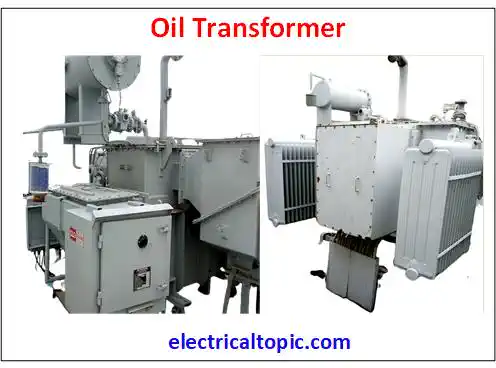
Q25. What is the difference between oil-immersed and dry-type transformers?

Answer: An oil-immersed transformer uses liquid for insulation and heat transfer, while a dry-type transformer uses solid insulation and air cooling or another declared arrangement. IEC 60076-11 covers applicable dry-type power transformers, and ONAN is a common designation for liquid-filled units. Compare ventilation, environmental class, fire requirements and routine maintenance access before choosing the type.

Read detailed article
26

Q26. What is an isolation transformer?

Answer: An isolation transformer uses separate primary and secondary windings to provide galvanic separation between the supply and load circuits. A 230 V/230 V unit can provide separation at a 1:1 ratio, but secondary earthing and protection depend on the installation design. Verify the earthing scheme and permitted loads before treating the output as isolated.

Read detailed article
27

Q27. What is the difference between a current transformer and a potential transformer?

Answer: A Current Transformer (CT) is connected in series with the line to step down high current to a standard 5 A or 1 A for meters and relays. A Potential Transformer (PT/VT) is connected in parallel across the line to step down high voltage (e.g., 11 kV) to 110 V for metering and protection.

Read detailed article
28

Q28. Why must a current-transformer secondary not be left open while primary current flows?

Answer: If a CT secondary is left open while primary current flows, there is no opposing secondary MMF, so the entire primary current acts as magnetizing current. This drives the core into heavy saturation, causing dangerously high secondary voltage (insulation breakdown/shock hazard) and severe core overheating. Always short the CT secondary terminals before disconnecting meters.

Read detailed article
29

Q29. What is an earthing transformer and why is it used?

Answer: An earthing transformer provides an artificial neutral where a system connection does not otherwise make one available. A zigzag winding is commonly used to carry zero-sequence current, and the neutral may be connected through a resistor sized for fault current and duration. Verify the neutral resistor and protection scheme against the earthing design.

Read detailed article
30

Q30. What is the difference between a core-type and shell-type transformer?

Answer: In a core-type transformer, windings usually surround core limbs, while in a shell-type design the core surrounds more of the winding assembly. Both designs may meet IEC 60076 requirements, but flux paths, winding layout and short-circuit forces differ. Identify the actual construction from factory drawings before planning winding repair or interpreting test results.

Read detailed article
31

Q31. What is the difference between a sealed transformer and a conservator-type transformer?

Answer: A sealed transformer accommodates oil expansion without normal exchange with outside air, while a conservator type provides an external expansion reservoir. Sealed designs may use corrugated tanks or a gas cushion, while conservator designs can use a bladder and breather. Check the manufacturer’s expected level and pressure indicators before diagnosing leaks or abnormal readings.

Read detailed article
32

Q32. Why is transformer capacity rated in kVA rather than kW?

Answer: Transformer capacity is rated in kVA because winding heating mainly depends on current and core excitation depends on applied voltage and frequency. In a balanced three-phase system, kVA = √3VLIL/1000, while useful kW also depends on the power factor. Check maximum current and load profile rather than judging available capacity from kW alone.

Read detailed article
33

Q33. What does a transformer rating of 11 kV/433 V indicate?

Answer: An 11 kV/433 V rating identifies nominal line voltages of the HV and LV windings for a three-phase unit. The line-voltage ratio at the reference tap is about 25.4:1, while actual service voltage depends on tap and loading. Compare the supply and the rated tap position before investigating an unexpected secondary reading.

Read detailed article
34

Q34. How is a three-phase transformer full-load current calculated from kVA and voltage?

Answer: Calculate three-phase full-load current by dividing rated apparent power by √3 times the line voltage on the winding being checked. For a 500 kVA transformer at 433 V, I = 500000/(√3 × 433), giving about 667 A. Use the HV line voltage to calculate HV current and compare both with the nameplate.

Read detailed article
35

Q35. Which important parameters are shown on a transformer nameplate?

Answer: A transformer nameplate identifies the ratings and connections required for operation, protection and replacement. Typical entries include kVA, voltage, current, frequency, vector group, percentage impedance, cooling class and tap data under the applicable IS 2026 or IEC 60076 specification. Photograph the plate and verify the exact tap and serial number before comparing test records.

Read detailed article
36

Q36. What is no-load or magnetizing current in a transformer?

Answer: No-load current flows in the energized winding when the opposite winding is open and mainly establishes flux while supplying core losses. Under IEC 60076 no-load testing, record current and watts at specified voltage and frequency, with values depending on design. Compare phase readings and voltage waveform with factory data before diagnosing an abnormal core condition.

Read detailed article
37

Q37. How are HV and LV windings identified?

Answer: HV and LV windings are identified by rated voltage and terminal markings, which must be read from the maker’s diagram. A transformer marked 11 kV/433 V has an 11 kV HV winding and a 433 V LV winding, regardless of which side is energized. Verify terminal identities and phase sequence before sanctioned connection work.

Read detailed article
38

Q38. What is the purpose of transformer winding insulation?

Answer: Winding insulation keeps turns, winding sections and energized parts electrically separated from one another and from earth. IEC 60076-3 covers insulation levels and dielectric tests for power transformers, with separate considerations for operating voltage and impulse stress. After a protection operation, assess insulation with the approved test plan before returning the transformer to service.

Read detailed article
39

Q39. Why is the LV winding usually placed nearer the core in a concentric-winding transformer?

Answer: The LV winding is usually nearer the earthed core because it generally needs less insulation clearance to the core than the HV winding. In a concentric 11 kV/433 V design, arranging the 433 V winding inside can simplify insulation and winding layout. Confirm the actual construction drawing before assuming this arrangement during repair.

Read detailed article
40

Q40. What is a transformer vector group?

Answer: A vector group specifies the HV/LV winding connections and the phase shift between them using clock-hour notation (each hour = 30°). In Dyn11, D = HV Delta, y = LV Star, n = LV neutral brought out, and 11 = LV voltage leads HV voltage by 30°. Matching vector groups is mandatory for parallel operation.

Read detailed article

Test Your Knowledge Through Mock Test

Basic Part 2 · Two tests, 10 questions each. Choose a test below to begin.

Question 1 of 100 / 10 answered

Your answers stay on this page.

KEEP LEARNING WITH ELECTRICAL TOPIC

Learn Faster. Improve Your Electrical Skills.

WEBSITE • EMAIL UPDATES

New guides. Straight to your inbox.

Subscribe free. Get fresh website updates.

Have a question? Email info@electricaltopic.com

Videos in Hindi

Electrical Topic on YouTube

Watch practical electrical lessons from our YouTube channel.

Visit channel