Ammeter Connection Diagram: Direct Series vs CT Wiring
1 - Ampere Meter (Ammeter)
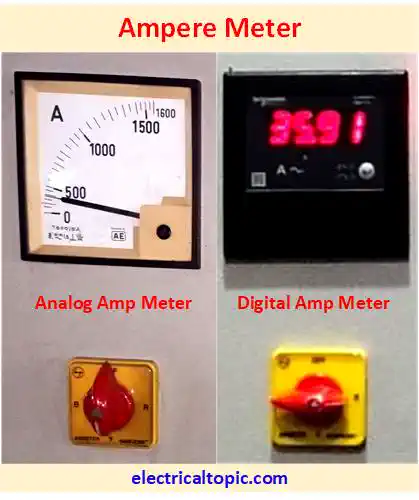
An ampere meter, or ammeter, is an electrical measuring instrument that measures current in amperes (A). Analog meters show the reading on a dial, while digital meters show it on a display.
Why an Ammeter Is Connected in Series
A direct-connected ammeter goes in series with the load so the same current flows through both. Its internal resistance is very low to minimise voltage drop. Connecting it in parallel across phase and neutral creates a near-short circuit. The resulting fault current can blow the meter fuse, damage the meter or cause injury.
2 - Ammeter Wiring Diagram
Direct Ammeter vs CT-Operated Ammeter Comparison
| Connection Type | Current Range | Wiring Method |
|---|---|---|
| Direct Connected Ammeter | Up to the meter’s rated direct input | Connect the meter in series with the load in the phase conductor. |
| CT-Operated Ammeter | Set by the CT ratio and meter range | Connect the meter input in the CT secondary loop (S1–S2). Match the input to the CT’s 5 A or 1 A secondary rating. |
3 - Types of Ammeter
Analog Ammeter
An analog panel ammeter uses a pointer and a graduated dial. For a CT-operated model, match both the meter input rating and its scale to the CT. For example, a 200/5 A CT delivers 5 A at 200 A primary current, so a matched meter shows 200 A at full scale.
Digital Ammeter
Digital ammeters show the current on a numeric display. A three-phase model can use a separate CT input for each phase and display each current without an external selector. Set the primary and secondary ratings in the meter to match the CT nameplate.
Ammeter Selector Switch (R–Y–B–OFF)
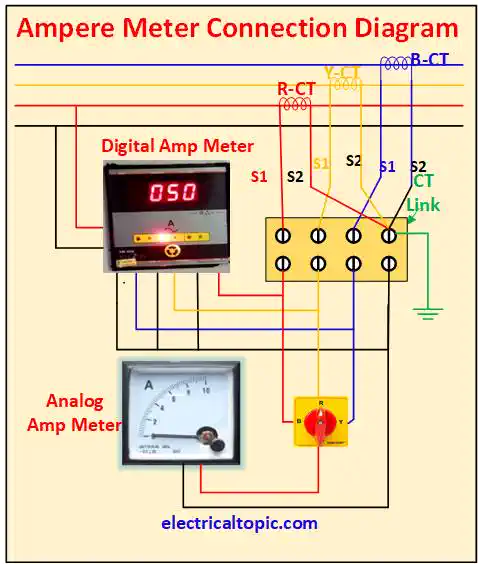
One metering CT on each phase lets a single panel ammeter read R, Y or B in turn. A CT-rated selector routes the selected CT secondary through the meter and shorts the two unselected CT secondaries. In OFF, all three CT secondaries are shorted and the meter is taken out of the measurement loop. Use a CT shorting selector that maintains a closed secondary path during switching. Follow the switch manufacturer’s contact and terminal diagram for the actual wiring.
The illustration identifies the CTs, meter inputs and selector. Where two meter inputs share a CT secondary, the approved panel schematic must keep those inputs in a series loop and the combined meter and lead burden within the CT rating.
Safety warning: Never leave S1–S2 open on an energized current transformer. With primary current flowing, a dangerously high voltage can develop across the open secondary. For meter removal, isolate the equipment under the site’s safety procedure and short S1–S2 at an approved CT shorting block before disconnecting the meter leads. Keep the short in place until the meter circuit is reconnected and verified. Schneider Electric CT installation guidance.
4 - Working Principle of an Ammeter
Analog Measurement
In a moving-iron AC meter, current through a coil creates a magnetic field that moves an iron element and its pointer against a spring. The calibrated dial indicates the current in amperes.
Digital Measurement
A digital meter senses the current, converts the signal to a digital value and displays the calculated reading. A CT-operated meter uses the CT ratio to display primary current. Choose a true-RMS model when you need to measure distorted AC current, such as on feeders with nonlinear loads.
5 - Uses of an Ammeter
An ammeter measures current in amperes. Use it to monitor feeder or motor loading, compare readings against rated current and check for phase current unbalance by comparing all three phase readings under similar load conditions.
To estimate AC active power, combine current with voltage and power factor. For a balanced three-phase load, kW = (√3 × line-to-line voltage × line current × power factor) / 1,000. To measure energy in kWh, use an energy meter that records active power over time.
6 - Indicative Price Range in India
| Panel Ammeter | Input | Indicative Unit Price |
|---|---|---|
| Analog, direct-connected | Rated load current | ₹550–₹1,000 |
| Analog, CT-operated | 5 A or 1 A CT secondary | ₹550–₹900 |
| Digital, 96 × 96 mm, single-phase | One CT input | ₹500–₹1,400 |
| Digital, 96 × 96 mm, three-phase | Three CT inputs | ₹1,600–₹2,200 |
These are budget ranges for the meter only. CTs, selector switches and accessories are priced separately. Quotes vary with the supplier, accuracy class, auxiliary supply, GST and brand, such as Selec, Schneider Electric, Lauritz Knudsen (formerly L&T Switchgear), Rishabh or Multispan.
Price references: Rishabh analog meter price list and Selec digital meter price list.