Single-Phase RCCB
Connection Diagram and Working Principle
1- Single Phase RCCB-Residual Current Circuit Breaker:
A residual current circuit breaker (RCCB) monitors the net current in the live conductors it surrounds. It trips when a qualifying residual current reaches the device’s operating condition.
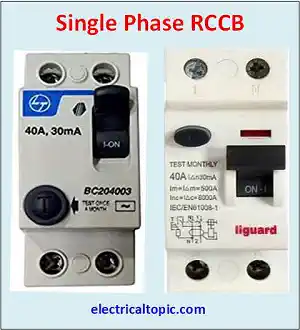
An RCCB provides residual-current protection. An RCCB has no integral overload or short-circuit protection. The circuit needs coordinated overcurrent protection, or an RCBO that combines both functions.
2- Single Phase RCCB Wiring Diagram.

3- Single Phase RCCB Working Principle:
Basic principle:
The basic function of RCCB is the same of Kirchhoff current law.
- With all current returning through the monitored conductors, their sum is zero and the residual-current trip does not operate.
- If current returns outside the monitored conductors, a residual current appears. Whether the device trips depends on its rated characteristics.
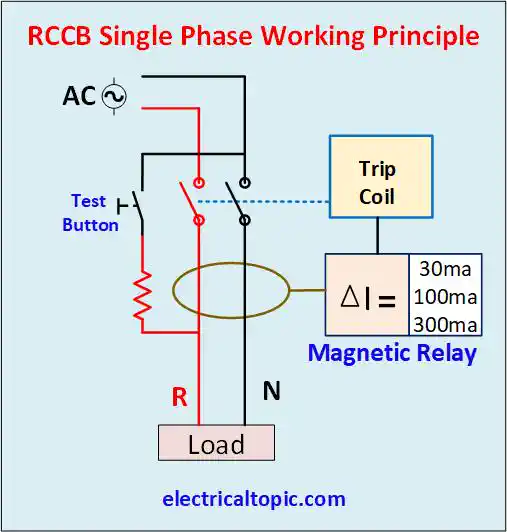
In a healthy single-phase circuit the line and neutral currents cancel in the sensor. If some current returns by another path, the sensor sees the imbalance. The RCCB operates according to its rated residual current and time characteristic.
4- Can we use RCCB single phase?:
A correctly selected RCCB can reduce the risk of shock or fire from some earth faults. It works alongside protective earthing, bonding and overcurrent protection. A current path between line and neutral alone may produce no residual current.